
Calm Your Baby Naturally Through Food Choices
As a huge natural living fan, I tend to take a more holistic approach when it comes to parenting, and naturally this includes colic and baby soothing solutions.
Through my learning process, I’ve learned that I made some mistakes. I made them because I didn’t know. That’s what happens when we are parents:
We do the best we can based on what we know.
I encourage you to try not to fault yourselves or feel guilty if you’ve made mistakes too. I call my son the experiment baby.
I am very committed to building on my knowledge of health and safety in my home, foods and products every day. I drive my husband nuts as a matter of fact.
But this is the fact: Babies are born with upwards of 200 chemicals in their cord blood. This is mainly due to what we are exposed to before and during our pregnancies.
One thing I really regret giving up on was breastfeeding. I did it for six weeks and wasn’t given the necessary support to keep trying. Instead it was suggested that he go on Nutramagen. Now that I am out of the rabbit hole so to speak, I can see things for what they are. The best way to nurse a fussy baby is by not giving up.
That being said I do recognize…trust me, I do…that it is very hard not to give up when your baby is screaming way more than smiling.
So I am writing this to you as your personal cheerleader and to let you know that there is more to consider when feeding a fussy baby.
If you are breastfeeding, it is best to live like you are pregnant. Taking care of your body will most often result in proper nourishment for your babe.
As parents of high need children our doctors oftentimes come to the conclusion that our babies are sensitive to our milk. Many times this is true but not for the reasons we may think. It is usually because of what we are consuming rather than because our bodies aren’t able to make milk properly.
They may tell us to remove dairy from our diets, etc, but a lot of us, myself included, end up switching to a hypoallergenic formula with easily digestible proteins.
As nursing mothers, If we notice our babies are struggling, maybe it is dairy. Or maybe there is something else we could be eliminating from our diet. There are still a lot of food sensitivities to consider.
But what about the genetically modified organisms, pesticides and other impurities most of us eat on a daily basis? The best thing we can do for baby while pregnant AND breastfeeding is to eat whole foods that are as organic or locally grown. It makes sense but few of us are being educated on the dangers found in your local grocery store. I think that needs to change. So do many others.
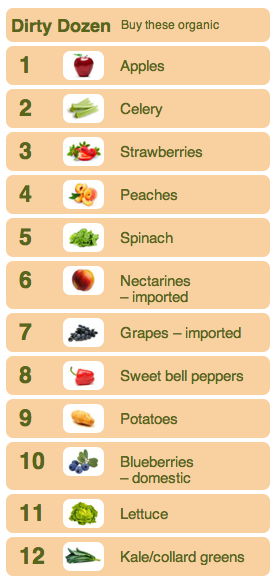
If you take a peek at the Environmental Working Group’s Dirty Dozen list provided here, you can get an idea of what produce should absolutely be organic like apples, strawberries, spinach, celery, blueberries and grapes.
If possible, some things breastfeeding mommies should consider avoiding are:
- Canned foods
- Mercury-rich fish like salmon
- Non-organic commercial dairy and meat
- Produce on the Dirty Dozen List
- Extremely processed foods
- Aspartame
- Splenda
You can also think of these suggestions as a good model for what to feed your infant once you begin feeding solids.
Getting in a variety of nutrients is very easy on a whole foods diet when you consider how many whole foods are ready to eat as is:
- Nuts
- Seeds
- Produce
- Green smoothies (a sure-fire way to get your vitamins and antioxidants in making both of your immune systems unstoppable. I personally love them despite their sinister green appearance.)
While making these changes will likely not ‘cure’ your fussy baby, at the very least, your bodies will both be less burdened by pesticides and food additives. Because we feel such a lack of control in regards to our babies’ reactions and mood, it is important to focus on things we can do.
I look forward to helping you further on this journey by sharing my experiences with my little screamaholic as well as things you might try to calm yours.
Keeping baby safe from physical stressors like chemicals is a step toward a calmer and happier baby….naturally.
“Action is the best antidote to despair.” ~ Joan Baez
For more information on what I’ve shared with you in this article please see these resources.
http://www.westonaprice.org/childrens-health/recipes-for-homemade-baby-formula
http://www.ewg.org/foodnews/summary/
http://www.epa.gov/pesticides/factsheets/kidpesticide.htm
http://www.nap.edu/openbook.php?record_id=2126&page=323
http://www.socialworktoday.com/archive/marapr2007p37.shtml
http://www.ncbi.nlm.nih.gov/pmc/articles/PMC1519860/pdf/envhper00375-0020.pdf
http://www.afhh.org/chil_ar/chil_ar_why_children.htm
http://www.neha.org/position_papers/PositionChildren.html
Amanda is the owner of Ready or Not – A Baby Planning Service. She is in love with her toddler and her husband and derives much of her writing inspiration from her family experiences. Being a mother of a formerly fussy baby, Amanda is very excited to share her story and contribute the Fussy Baby Site’s blog. To learn more about Amanda and what she does to help pregnant and new parents, please check out her website at www.readyornotbabyplanning.com.
Photo Credit: Gammeana
Category: Guest Posts, High Need Babies


This is interesting because I was thinking about this a lot just this morning and my husband and I had a “back at the drawing board” talk YET AGAIN this a.m.
I was also highly encouraged to switch to hypoal. formula but am persevering bf (five months now!) I sometimes doubt my choice when she’s no better and won’t sleep. I’ve been dairy free for over three months now.. Ugh. And was soy, egg, wheat etc. free for a solid three weeks.
I now think maybe she had improved when I was off those things b/c our sleep pattern has worsened and she gets a rash all over her face and neck…
(there is a family history of soy, egg and dairy allergy)…
Our friends recently had a second and they were saying their first was like ours and they found out when she was FIVE that she is allergic to wheat, dairy and eggs (she had lots of GI problems). And she never slept. (She is better now).
Do you know if there is research on sleep problems and food sensitivities? I mean.. why isn’t there more on this correlation?
Georgia – that is a good question! I don’t know of any research on sleep and food sensitivities, although I’d have to believe they are correlated. Definitely fussiness and poor sleep are linked, and since fussiness is sometimes causes by food sensitivities, there’s definitely a link. Let me know if you find anything!
I second the above comment. Babies can be sensitive to so many things. They can’t tell us, and it can be maddening to try to figure it out via elimination. I know allergies can make for a very uncomfortable baby. And this blog is to just bring up some other possibilities that could be indirectly affecting your baby. I encourage you to do some exploring on the links I included on this blog to learn more. I think it is great to keep trying and also to find a lactation consultant if you haven’t been working with one already. Sometimes they just don’t get the right balance of hind milk which can cause irritability too.
Of course, it’s always a good idea to eat whole, natural, organic foods. But I would really caution anyone who is considering an elimination diet, especially when breastfeeding, to consult with a healthcare practitioner prior to beginning. It is very important when you are breastfeeding to get a well-balanced diet with sufficient energy and fat. Both for the baby and for mom. I would also be curious to know if anyone has any information on ways to eat well when you are VERY strapped for time and energy, as this is the case when you have a very fussy baby!! We all know that when we are tired and stressed we tend to reach for easy (and usually unhealthy) food options because we just don’t have the time to plan, shop for and prepare healthy food. Or maybe we just think we don’t….I would love some suggestions!!
Great article Amanda! Having a fussy and/or colicky baby is not fun; and I appreciate your comment about although there’s much we can’t control, we must control the things that we can…diet being a big one.
I found cutting out dairy helped, but it’s important to read food labels. A lot of people assume that cutting out dairy means not having milk, cheese and yogurt, but there are SO many products out there that have milk ingredients in them…and you need to cut out all of them to truly cut out dairy. It’s tough, and not much fun, but can be very beneficial. It helped with my daughter’s fussing and we saw incredible improvements to both her complexion and my own. That was 2 years ago and I still don’t eat much dairy!
@Surviving Baby Colic – thanks for the comment! You’re very right…you often need to cut out ALL dairy not just the obvious ones. For my Sammy, it has to be even trace amounts, but once his digestive system matured a bit around 4 months I was able to slowly introduce it again (thank goodness!)
Good things to think consider! I struggled with thinking there was a food sensitivity in my daughter for months. I did a 2 week Total Elimination diet consisting of only organic: pears, rice, squash, and turkey. It was hell. I was already agitated from being overtired and home with a high needs baby all day–I was now hungry and stressed out about whether or not there were any positive changes in her crying/fussiness as a result of my elimination diet. There weren’t. I ended up breastfeeding for 16 months until she weaned herself. I can’t tell you the number of times I contemplated switching to formula (during the first few months). While I know “breast is best”–in hindsight, the trade off was pretty great in terms of the toll it took on me emotionally and physically. I would probably do it the same way again–but it honestly was a really stressful and complicated aspect to parenting a high needs newborn.
For Julie,
Yes, absolutely I think we should consult professionals when making dietary changes. Organic and whole foods are pretty safe switches. In my blog I mentioned having raw foods around that can be eaten with one hand like nuts, seeds, produce and pre-made smoothies. One handed eating is key with a fussy baby. I’d also suggest wearing baby while preparing food, as long as you aren’t doing anything dangerous.
It takes 6-8 weeks for your body to rid itself of milk and can take up to 9 months or more for your body to stop reacting to it. It lowers your immune system no matter who you are because your immune system sees it as an invader and tries to get rid of it. Milk was made for baby cows to grow large, not for humans. Make sure if you do cut-out milk, give it some time and do not cheat if your child’s colic is severe. It will take your body 6-8 weeks to get rid of one piece of cheese. And yes, it is found in almost everything, from hot dogs to bread. I know all of this because my son is highly sensitive to milk. He breaks out in a rash and gets an ear infection within a week. Food allergies of any kind can affect your immune system, attention, behavior, digestion, brain, senses, and skin, which can all affect sleep. Also, an infant’s intestines are not fully developed until they are 4 or more months old. To play it safe, do not feed your child any solid food (including rice) before 6-8 months old. If you do, your child’s digestion will be affected for the rest of his or her life and can even cause obesity in your child.
http://abcnews.go.com/Health/w_ParentingResource/introducing-solid-food-puts-babies-risk-early-obesity/story?id=12856918